Video works:I created several video works for the project. One was a Stop-Go Animation,[vimeo 273833616 w=640 h=360]516748 K VennerWoodbridge Video Fractured Foam from Katie Venner-Woodbridge on Vimeo.I did not create a storyboard or plan for this. I cut up some foam that was supplied by a friend and set about creating a small sequence. I wanted to explore order and chaos in a very simplified format that would still maintain the air of my work. By looping the video it reflects the daily routines and repetitions that I am so fond of and displays the way they ebb and flow. In hindsight, the material was not great and moved very easily if there was a breeze etc. I would also make a storyboard next time to make sure that the piece flowed steadily and developed into a more choreographed piece.After a tutorial with Kimberley Foster, we discussed the temporaryness of the drop collage pieces and I decided I would turn them into a performance and record it.[vimeo 273836648 w=640 h=360]516748 K VennerWoodbridge Video Performance Drop Collage sml from Katie Venner-Woodbridge on Vimeo.This piece as has a timelapse but I couldn't get the file to edit properly. I watched it on the camera and it felt so rushed I was happy to keep the real-time video. The element of sweeping the pieces away and starting afresh is cleansing, like a good night sleep. If the pieces don't land favourable, sweep them away and drop them again. Having chance play a role through the act of dropping also brings another element of chaos into the work. I would like to take this to a larger audience and allow participants to create the work and ask their reactions, so if they feel the need to stop when they have a favourable layout etc.Lastly, I created a large Performance piece, this was after speaking to Les Bicknell and his suggestion of making a systematic piece. It had also come up in a previous group critique. I set about planning pieces and drew out a 4x4 (5cm each so 20cm x 20cm) square on a piece of cloth. I then set up a filming area and proceeded to set a timer for 10 minutes and an alarm to remind myself to do the task daily. I tested the fabric would work first on a scrap.


 I proceeded to punch embroider everyday for 10mins inside on of the squares, a couple of the day I didn't finish, the rest I had to stitch over as I was faster than expected.


 Once I had done the first 16days I began to unpick the work. This did not need a timer. I systematically unpicked each square carefully bundling up the yarn for display afterwards. This is in honour of Hassan Sharif's piece "Cotton" pictured below. Which is a video installation alongside the artefact of the lump of cotton her created.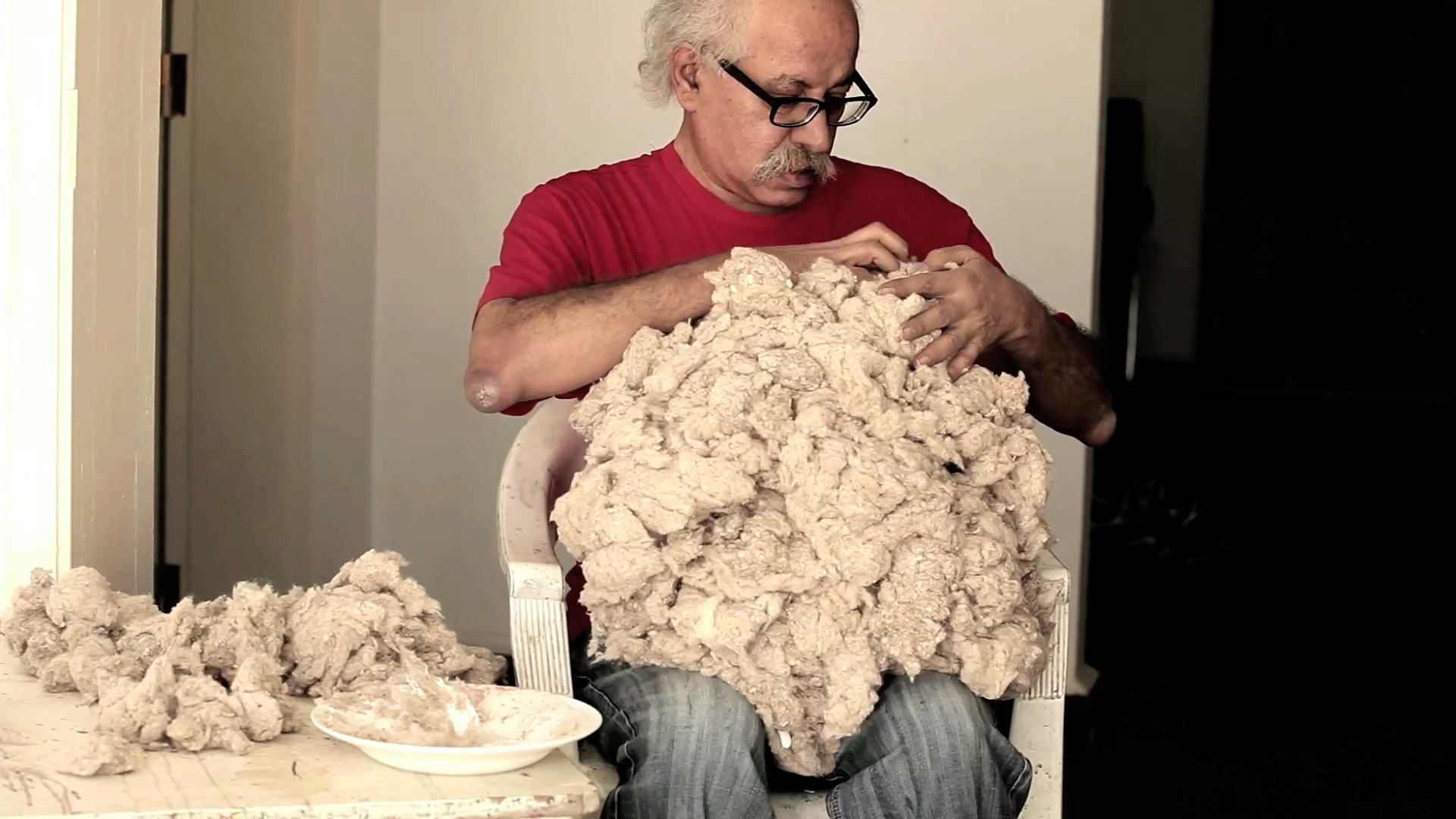
Hassan Sharif, Cotton (still), 2013. Cotton and single-channel HD video, silent, 20 x 67 x 46 cm, 8 minutes 26 seconds. Courtesy Estate of Hassan Sharif and Gallery Isabelle van den Eynde, Dubai. http://sharjahart.org/press/sharjah-art-foundation-presents-landamrk-hassan-sharif-retrospective-i


 The video would be displayed alongside the artefacts and played on a loop. It is 3:36 hr: mins long. I chose to leave it like this as the point of the use of the techniques was its rhythmic movement and sound. It is tedious to watch, mirroring the common thought fo the 'daily grind' but in its sum creates a textile piece. As the chaos ensues ans it comes apart a different, perhaps more aesthetically pleasing textiles arises.[vimeo 273833967 w=640 h=360]516748 K VennerWoodbridge Video Performance deConstruct from Katie Venner-Woodbridge on Vimeo.
 My initial batches were coarse and grey as I was using a substandard blender and the paper had a lot of printer ink on it. It was also heavily textured due to the fabric I was using to place it on. I replaced that and fixed the other teething problem and created some almost white paper. I was trying to maintain an element of transparency but this proved to be very difficult with the paper tearing and breaking up.
 Once I dry I did some ink experiments with the pieces. Because the paper doesn't go through any finishing processes it is absorbent and allows the ink to bleed through. I think this could be made a feature but where it absorbs too much ink it very quickly disintegrates.

 I next used threads in the process of papermaking, laying them on and in the paper solution as I was creating the sheets. This relies on the paper fibres to hold the thread in place and is not the most secure way of doing it. After a short time, the threads began to come away from the paper. I also sandwiched the threads between sheets but this rendered the paper very thick and the threads not as visible.


 I do really find something pleasing about the piece that created holes, this unperfect aspect in an art form that prides itself on perfection moves me back into the thinking of chaos and order.
 I did stitch a piece but it doesn't photograph well, this is a piece of Japanese paper that was also stitched. It holds the threads well whereas my handmade paper tore quickly and I abandoned stitching it further to save the piece. Perhaps the next point would be to continue until is does destroy itself and see what happens.

 Below the back can be seen, its relatively straight lines and the top is more chaotic.
 I am considering how this would work on a large scale where the height of the pile can be changed and the textures would highlight the geometric structure further.I also used crossstitch, and punch stitch to explore how these geometric can translate in to stitch.


 I found them frustrating. I longed for density in these pieces either by layering transparent fabric over each other or by building up textures and stitch density. There is a long way to go with the textile aspect of this exploration.


 I moved on to cutting these forms out and playing with the idea of layered collages to build up density that can be moved. The collages are not fixed and therefore have boundless configurations adding an element of temporary chaos to their organisation. A small breeze would change them, an event that's tiny causing a larger repercussion.
 While dropping the pieces they began to entangle and build up into these half-collapsed forms. allowing for the consideration of 3D to leap off the page.

 I moved forward by looking into the thickness of the line, the thinner the line, the more fragile the piece appears.


 These pieces were created using a 1inch paint pen. The paper started to bend and curve with the ink. The structures are less intricate but have far more of a density to them, a presence.


 Transfering these ideas back to stitch, I used card and the recommended influence of Fred Sandback to explore moving the lines into an installation. I created some maquettes. One has a base and a ceiling, the threads would be suspended from both, creating a web of vertical lines to walk in and out of.


 The second was purely of suspension. Inspired by Hassan Sharifs hanging pieces that were seen at his retrospective, the thread would come down from the ceiling and amass on the floor, making it difficult to walk through the space.

 In creating the piece and laying it down for photgraphy I was actually very drawn to it as a piece in its own right. The chaotic hanging threads shielding the geometric stitch design behind them.
 I went on to revisit the white piece and play with how that could become a small piece in its own right too. This was more of a struggle and moves back to the book work so I will look at how I can link the two.
 As I was determined to at least try the 3D work I used modelling straws (from my teaching kit!) to tape up some simplified designs I created in Adobe Illustrator. They proved to be very poor quality and frustrating so rather than waste time with them I moved forward.
 Lastly, I cut a piece from card, it is 50cm x 50cm and a laborious task. The issue once it was complete was that it was still a flat piece. Multiple pieces would have to be cut and slotted together but this didn't feel like the right route to go down.
 After this, I decided to forgo the laser cutter as this would have given more flat pieces. and I put the 3D work on hold for this project. I would like to investigate the ways sculpture can be subversive and involve the viewer in touch by creating something that looked hard and metallic but was actually plush and soft.